
Game Controls
- Left Click + Drag: Place the selected element on the canvas
- Mouse: Select elements, categories, and tools
- Erase: Remove pixels
- Drag / Pick: Move or select existing materials
- Mix: Mix nearby particles
- Heat / Cool: Raise or lower temperature
- Shock: Apply electricity
- Smash: Break or disturb materials









Sandboxels
Introduction to Sandboxels
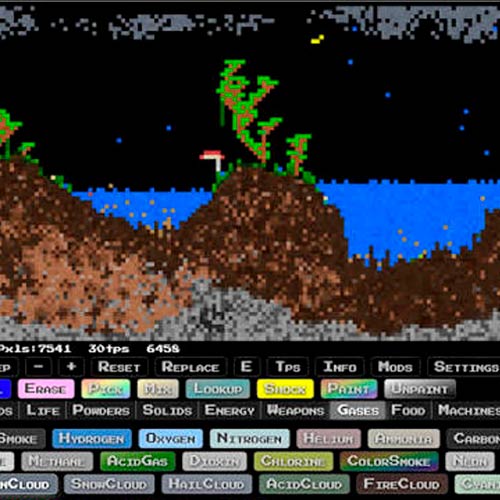
Sandboxels is a free falling-sand sandbox simulator where tiny pixels become the building blocks for surprisingly complex experiments. Built around physics, science, and open-ended experimentation, you choose materials such as sand, water, gases, plants, fire, and chemicals, place them on the canvas, then watch their properties interact. Heat, density, electricity, combustion, and chemical reactions can turn a simple pile of particles into a chain reaction within seconds. With 500+ elements and thousands of possible interactions, much of the fun comes from asking “what happens if I mix these?” and finding out the messy way. It plays directly in the browser, making experimentation the entire point rather than a side mechanic.
Sandboxels Highlight Features
- 500+ elements: Experiment with solids, liquids, gases, powders, life forms, machines, food, and many other materials.
- Particle-based physics: Materials fall, flow, spread, burn, melt, freeze, or react according to their properties.
- Heat and fire simulation: Temperature can dramatically change materials and trigger spreading reactions.
- Chemical interactions: Combining certain substances produces new reactions rather than simply overlapping pixels.
- Electricity and machines: The sandbox extends beyond natural materials into energy and mechanical experiments.
- Creative tools: Heat, Cool, Shock, Paint, Smash, Mix, Erase, and other tools give you direct control over experiments.
- Open-ended sandbox: There is no required objective, leaving you free to build ecosystems, create disasters, or simply make pixel art.
Gameplay Guide for Sandboxels
Sandboxels is about understanding cause and effect. Small experiments can quickly develop into much larger simulations.
Gameplay Mechanics
Start by choosing a category such as Liquids, Life, Powders, Solids, Energy, Gases, Food, or Machines, then select an element and place pixels on the canvas.
Gravity immediately matters. Sand piles up, while liquids flow into available spaces. From there, temperature and material properties make things more interesting. Add fire to combustible material, cool something down, introduce water, gases, electricity, or chemicals, and the scene can change on its own.
The toolbar gives you another layer of control. Heat and Cool alter temperature, Shock introduces electricity, while Mix, Smash, Paint, Drag, and Erase help reshape an experiment without starting over. That freedom makes Sandboxels equally useful for careful simulations and spectacular pixel-sized disasters.
Game Controls
- Left Click + Drag: Place the selected element on the canvas
- Mouse: Select elements, categories, and tools
- Erase: Remove pixels
- Drag / Pick: Move or select existing materials
- Mix: Mix nearby particles
- Heat / Cool: Raise or lower temperature
- Shock: Apply electricity
- Smash: Break or disturb materials
Tips and Tricks
- Experiment on a small scale first. A few pixels make reactions easier to understand before things get chaotic.
- Use barriers to contain reactions. Separating materials gives you more control over fire, liquids, gases, and chemicals.
- Watch temperature closely. Heating or cooling can completely change how some substances behave.
- Combine tools with materials. Heat, Cool, Shock, and Mix can reveal interactions that placing elements alone may not.
- Build layered environments. Soil, water, plants, gases, and heat sources can create much more interesting simulations than isolated materials.
Pick a material, add another, and see how far one tiny reaction can spread in Sandboxels.